Guide · TV Mounting
TV wall mounting in London: what it costs in 2026, and what's behind your wall
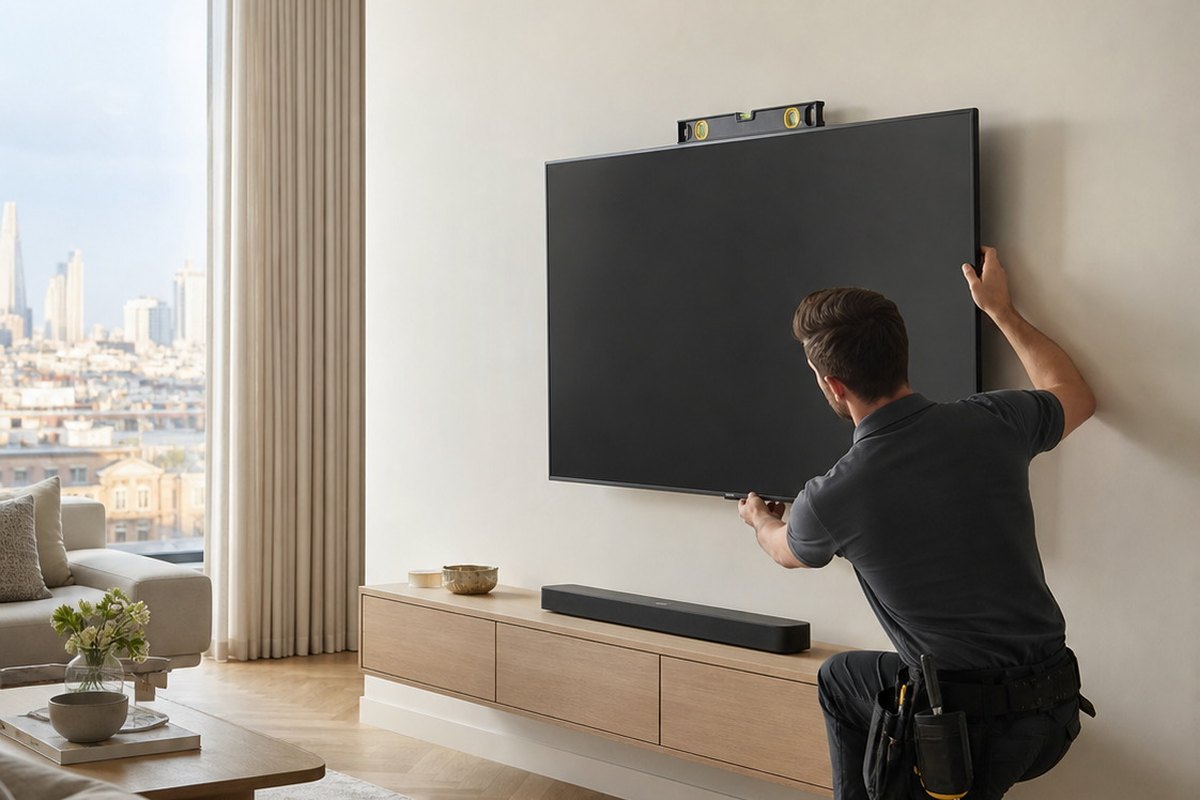
A clean TV wall mount looks like a five-minute job. In a London flat it rarely is. The screen is the easy part — the wall behind it decides everything, and London hands you every wall type going: hollow plasterboard on metal studs in a Canary Wharf tower, 150-year-old solid brick in a Victorian terrace, and reinforced concrete you can't get into without an SDS drill. This is a practical guide to TV wall mounting in London in 2026 — what it costs by screen size, which bracket to choose, and how the right fixing keeps a 65-inch screen on the wall for good.
TV mounting cost in London by screen size
Hausio prices TV installation in London as a fixed job rather than by the hour, so the figure you're quoted is the figure you pay. Price is set by screen size, and it stays the same whether we're drilling into plasterboard, brick or concrete:
- Up to 43" — £55
- 44–55" — £75
- 56–65" — £95
- 66–85" — £150
Two charges sit on top of that only where they apply: a flat £18 access charge inside the Central London Congestion Zone (EC, WC, W1, SW1 and SE1 postcodes), and a £15 same-day surcharge if you need a fitter out before 8pm today. Brackets are supplied at cost with no markup, or you can supply your own. Anything non-standard, such as a partition wall that needs a timber batten fitted first, is quoted at standard London handyman rates before any drilling starts, never sprung on you at the end.
Fixed, tilt or full-motion: choosing the bracket
The bracket matters more than most people expect, both for how the TV sits and for what the wall can safely carry. Three types cover almost every London living room:
- Fixed (flat) mount — holds the screen 2–3cm off the wall for the tidiest, most flush look. Right when the viewing height is already correct and you don't need to reach the ports behind. The cheapest and strongest option.
- Tilt mount — angles the screen down 10–15°. Worth it whenever the TV goes higher than eye level, in a bedroom or above a media unit, and it kills the reflection from a window opposite.
- Full-motion arm — extends and swivels, so you can watch from a galley kitchen, a corner sofa or the dining table. It is heavier and levers hard on the wall, which is exactly why the fixing underneath it is non-negotiable: a full-motion arm anchored into plasterboard alone will pull out. On a stud wall it has to reach solid timber or steel.
The London problem: what's actually behind your wall
This is where a proper TV installation in London is won or lost. Four wall types come up again and again, each needing a different anchor:
- New-build plasterboard on metal studs — the standard in Canary Wharf (E14), Stratford (E20), Nine Elms and Wembley Park. For a TV installation in Canary Wharf or any Stratford new-build, the partition is a plasterboard skin over hollow metal C-studs. A 55-inch screen must fix into the steel stud with the correct spring-toggle anchors, or onto a timber batten spanning two studs — plasterboard plugs on their own will not hold it.
- Solid London stock brick — Victorian terraces and conversions across Islington, Hackney and Clapham. The chimney breast is the classic spot: solid brick, drilled with a hammer drill and sleeve anchors, keeping the fixings in the brick and out of the soft lime-mortar joints.
- Reinforced concrete — shear walls in the Vauxhall and Battersea towers, and party walls in older mansion blocks. These need an SDS drill, M8 wedge anchors and dust extraction so the drilling doesn't ruin the carpet.
- Period and listed flats — West End mansion blocks around Oxford Street, Marylebone and Fitzrovia, where the lease often bans chasing into walls. Here the answer is a reversible, surface-mounted solution that comes off cleanly at the end of the tenancy.
Hiding the cables: trunking or in-wall
A mounted TV with cables dangling below it undoes the whole job. There are two honest ways to deal with them, and the right one depends — again — on the wall:
- In-wall concealment — for plasterboard or any hollow cavity. Power and HDMI drop down inside the void through a low-voltage capsule kit to a socket behind your media unit, so nothing shows at all. Mains can't simply be run loose inside a wall, so we use a bridged-socket kit that stays compliant.
- Surface trunking — for solid brick, concrete or any rental where chasing isn't allowed. Slim paintable trunking, colour-matched to the wall, that hides the run and lifts off without damage when you leave.
What's included, soundbars, and how long it takes
Every Hausio TV wall mounting visit includes the level-set, lifting the screen onto the bracket, a power-on test, an angle check from where you actually sit, and a quick walk-through of the tilt range so you can adjust it later. The cable drop behind the unit is standard, not an extra. If you want a soundbar mounted and aligned beneath the screen — a Sonos Arc or Beam, say — we can mount and align it in the same visit.
Timing is straightforward. A single-screen mount takes 45–90 minutes. Add cable concealment and it's closer to two hours. A full home-cinema set-up — TV, soundbar, Sky or Virgin box relocated, everything hidden — can run to half a day. Every fitter is DBS-checked, interviewed in person and fully insured (£2M public liability), and you pay £0 at booking: settle by card, Apple Pay or Google Pay only once the screen is up and tested. If you've been searching for TV wall mounting near you anywhere in Greater London, you can book online in about 60 seconds, seven days a week, 8am to 8pm.
Book London TV wall mounting
Fixed price by screen size, from £55, and £0 at booking. Send us the TV model and a photo of the wall — we'll confirm the bracket and the right fixing before we arrive, then you pay by card, Apple Pay or Google Pay once it's up and tested.
Book your TV mount